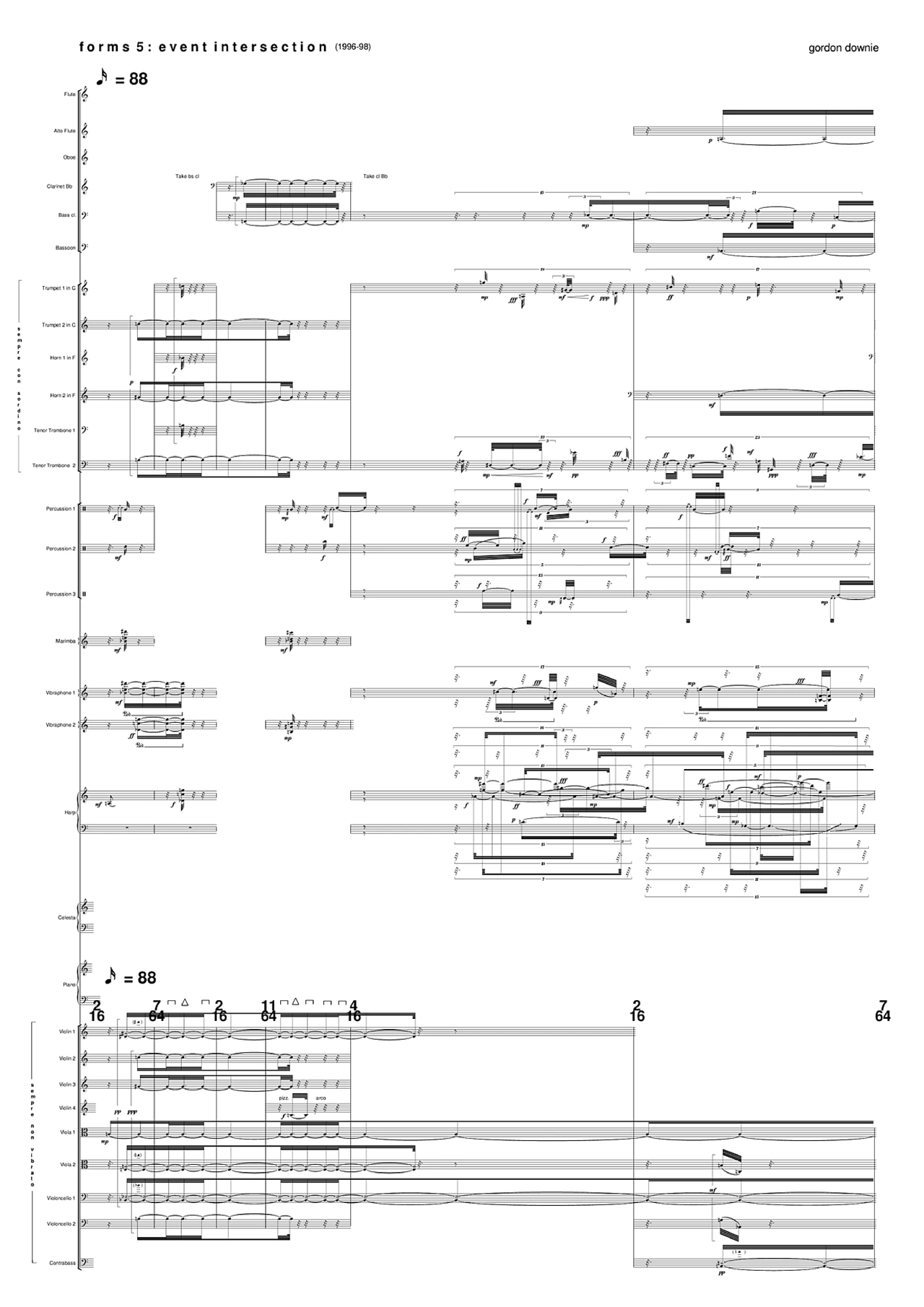
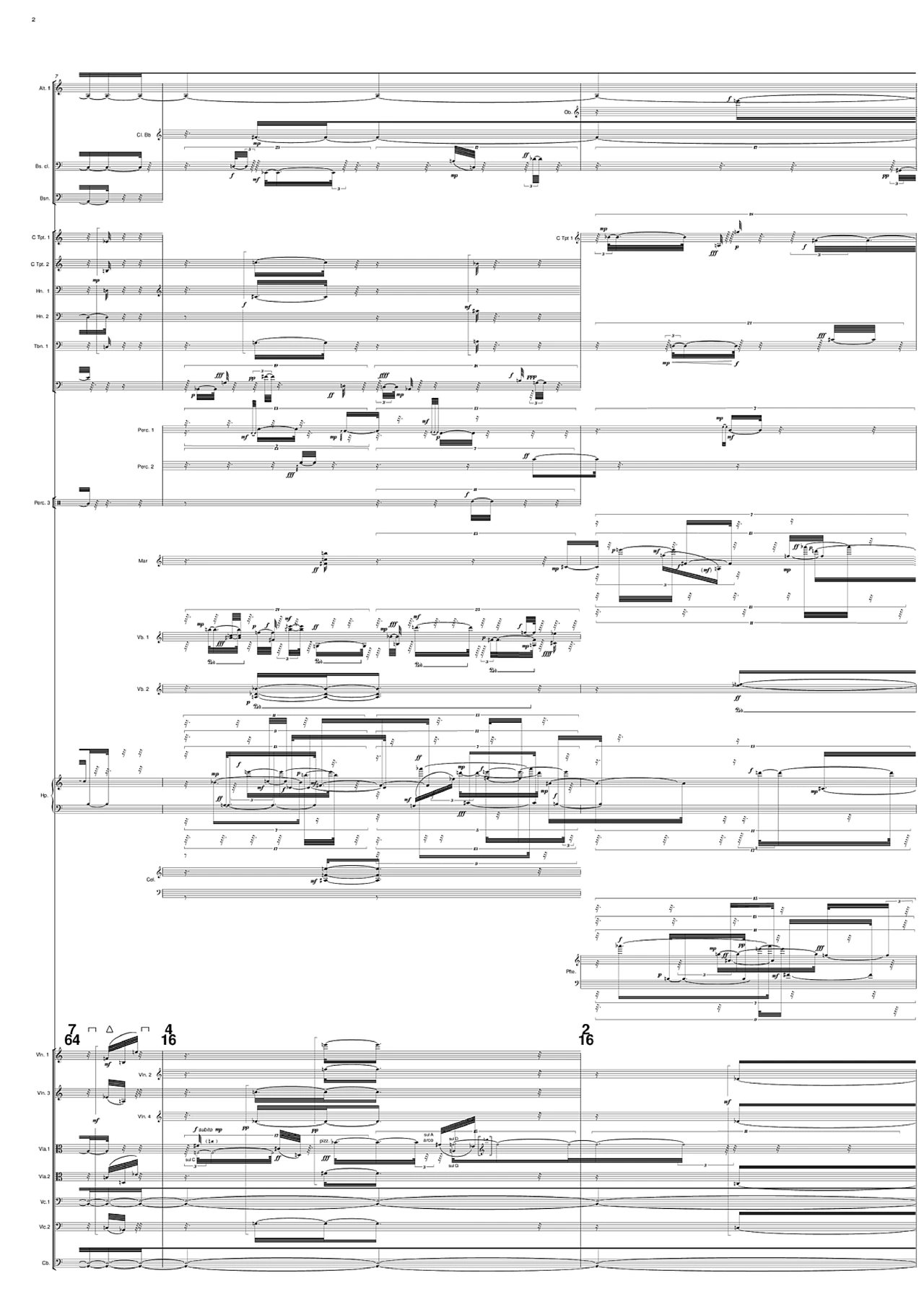
forms 5: event intersection
gordon downie
- Program Notes
forms 5: event intersection is characterised by a process of mediation between maxima and minima: most fundamentally, relatively fine-grained mediation between extremes of point density, applied at an inter-event level both sequentially and concurrently.
Two extremes are established of high density on the one hand, and relatively low density – or sparsity – on the other. The two extremes are then mediated to produce a 7-element scale of density from high to low. The elements form the basis of 7 event classes which are permutated to form 7 distinct series, constituting the formal design of the work.
Dictating event succession is a formal process of inter-event negation, whereby juxtapositions are favoured which highlight maximum differentiation.
In addition to that of density, to each event class is associated a set of class attributes which further assist the structural definition and perceptual differentiation of one class from another. These include instrumental configuration, event duration, and point distribution.
This formal design constitutes the basic structural arrangement for forms 5’s predecessors. However, through the superimposition of events, this otherwise sequential process is extended in forms 5, resulting in the temporal coincidence of distinct event class instances. This factor determines the larger instrumental forces required in forms 5, to enable the simultaneous delineation of distinct instrumental groupings.
Set operations such as these are exhibited by the music at every parametric level. With regard to pitch organisation, the work is constructed from two pitch-class sets, <0,1,4> and <0,1,6> using Forte’s classifications and pitch class set notation, to which are applied transposition and permutation, and the set operations intersection, union, and complementarity.
Glossary:
Attributes:
Characteristics or properties that in combination assist the formation of distinct classes.
Class instances:
Specific occurrences or instantiations of event classes. For example, given event A, specific instances of this event are listed as event A 1..n
Event classes:
A collection of similarly profiled events sharing similar attributes and behaviours.
Mediation:
A non-hierarchical process functioning to reconcile difference between structural components of a work with a view to giving each component equivalent structural status. Historical precedents in De Stijl’s notion of equivalence.
Point distribution:
The dispersion of points – or notes – per unit of time. Within a given time period, points can be distributed evenly or clustered into temporally delimited locations within a time period.
Parametric:
A musical parameter is a distinct feature which combines with other features to give an identified musical utterance a distinct identity. Parameters conventionally comprise pitch, duration, loudness, and timbre. They can also be higher level features such as point density and distribution, in addition to proximity and similarity relations. Composing parametrically focuses attention to the materials of musical form and those structures generated to organise them.
Negation:
A given musical object or utterance will have associated with it defining characteristics, attributes, or parameters. At a point level, such parameters include pitch class, dynamic, duration, and timbre. At a group level, when individual points associate to form a higher level grouping, such parameters include both the latter in addition to instrumental configuration, density, spatial assignment, and so forth. Sequences of points or groups can exhibit varying levels of correspondence with their predecessors by replicating their characteristics, or by negating them, by exhibiting contrasting parametric profiles. A negation matrix controls this process: rows list event attributes whilst columns list event identifiers, 1-4. Entries indicate how values of parameters are updated from event to event, forming profiles which mutually negate one another.
- Recording Notes
forms 5: event intersection was premiered by the Contemporary Music Ensemble of Wales, conducted by Grant Llewellyn, in April 1999, as part of the Explorations Festival of Contemporary Music, in Studio 1, BBC Broadcasting House, Cardiff, UK. The work was later broadcast on BBS Radio 3’s Hear and Now, May 2001.
Instrumentation:
Flute, alto flute, oboe, clarinet Bb/bass clarinet, bass clarinet, bassoon, 2 trumpets, 2 horns, 2 trombones, marimba, vibraphone 1, vibraphone 2, harp, celesta, percussion 1 (maraca, guiro, 5 temple blocks, 2 bongos), percussion 2 (maraca, 5 woodblocks, 2 timbales, 3 tom toms), percussion 3 (maraca, guiro, 5 log drums, 2 congas), 4 violins, 2 violas, 2 cellos, 1 double bass.
- Performer Credits
- Contemporary Music Ensemble of Wales, conducted by Grant Llewellyn
- Publisher
- Edizioni Musica Critica